
About the Author
Hi! I'm Stefano, founder of Transparency Foods. The cholesterol research behind psyllium husk is strong enough that it earned an FDA-authorized health claim, one of only a handful of ingredients to ever receive that designation. I wanted to walk through exactly how it works and what the research shows, because I think it's an underappreciated reason to take Lusy.
Having said that, please know that Lusy, or any psyllium husk product, is not intended to treat high cholesterol. That would make it a drug, and Lusy is not a drug; it's a dietary supplement. It will help lower cholesterol levels already within a healthy range.
Here's what we'll cover:
- Why LDL cholesterol matters
- How psyllium husk — the active ingredient in Lusy — lowers LDL
- What the clinical research shows, including the FDA health claim
- How to use Lusy for cholesterol management
- What kind of results to expect
Why LDL Cholesterol Matters
LDL cholesterol — the "bad" cholesterol — is one of the most important risk factors for heart disease. When there's too much of it circulating in your bloodstream, it contributes to plaque buildup in your arteries over time, raising your risk of heart attack and stroke. Diet, exercise, and in many cases medication all play a role in managing it — but there's a real, well-documented dietary intervention that often gets overlooked: psyllium husk.
How Psyllium Husk Lowers LDL
The mechanism here is genuinely elegant. Your liver uses cholesterol to produce bile acids, which are essential for digesting fat. Normally, those bile acids are reabsorbed in the small intestine and recycled — your body reuses the same cholesterol over and over.
When psyllium's gel is present in your gut, it binds to those bile acids and carries them out of your body instead of letting them get reabsorbed. Your liver then has to make new bile acids to replace what was lost — and to do that, it has to pull LDL cholesterol out of your bloodstream. The net result is lower circulating LDL, achieved by your own body's normal cholesterol-recycling machinery, just redirected.
What the Research Shows
A meta-analysis published in the American Journal of Clinical Nutrition (Jovanovski et al., 2018) pooled results from 28 randomized controlled trials involving nearly 1,900 subjects. At a median dose of around 10g per day, psyllium supplementation reduced LDL cholesterol by approximately 13 mg/dL (about 0.33 mmol/L) compared to placebo. It also lowered non-HDL cholesterol and apolipoprotein B — additional markers for cardiovascular risk.
That's a clinically meaningful reduction — comparable in magnitude to what some mild cholesterol-lowering medications achieve — and it comes from food, not a prescription. A separate 2019 analysis found that people with the highest dietary fiber intakes had 15–30% lower risk of cardiovascular-related mortality compared to those with the lowest intakes.
The FDA health claim: In 1998, the FDA authorized a health claim specifically for psyllium husk and cardiovascular disease — one of only a handful of ingredients to ever receive this designation. The claim states that diets low in saturated fat and cholesterol that include 7 grams of soluble fiber per day from psyllium seed husk may reduce the risk of heart disease. To legally make that claim, a product has to contain at least 1.78 grams of soluble fiber from psyllium per serving. Each serving of Lusy clears that bar comfortably.
How to Use Lusy for Cholesterol
The dose used in most of the strongest trials — and the one that aligns with the FDA claim — is around 7–10 grams of psyllium husk per day. Each scoop of Lusy delivers 5 grams, so two servings a day gets you into that range.
- Take it with meals. The bile acid-binding mechanism depends on food-stimulated bile secretion, so taking psyllium alongside a meal — rather than on an empty stomach — is when it does the most work.
- Mix with a full glass of water (at least 8 oz / 240ml) and drink promptly.
- Be consistent. This is a cumulative effect, not something that shows up after one serving — daily use over weeks is what the research is based on.
Why Lusy Specifically
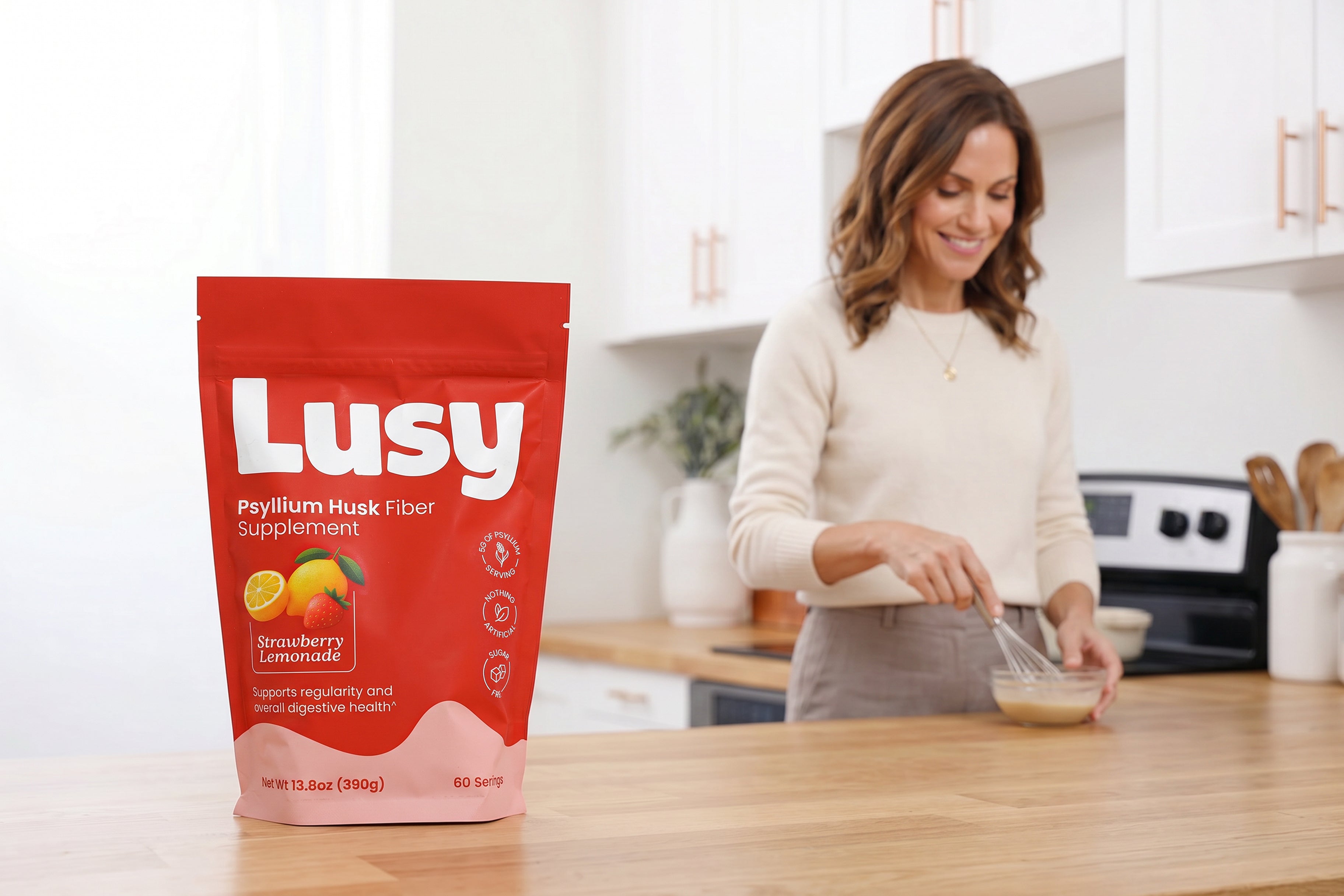
The active ingredient doing the cholesterol work is the psyllium itself, so purity and dose actually matter here. We use organic, high-purity psyllium husk in Lusy, and each serving is formulated to deliver a meaningful, trial-relevant dose of soluble fiber — not a token amount diluted by fillers. We also skip the maltodextrin that some competing products add to improve mixability, which has no bearing on cholesterol but does nothing to help it either. Oh, and did I mention that Lusy tastes absolutely amazing?! You can find Lusy here.

What to Expect
Unlike regularity, which can improve within days, the cholesterol benefit is slow and cumulative. Most studies that show a measurable LDL reduction ran for at least 4–8 weeks of consistent daily use. If you're tracking your lipid panel, a reasonable approach is to start daily use, stay consistent for 6–8 weeks, and recheck your numbers at your next routine test.
If you're on cholesterol medication, psyllium is generally considered complementary rather than a replacement — talk to your doctor about how it fits alongside what you're already taking, and take it 1–2 hours away from any prescription medications since psyllium can slow their absorption.
Closing Thoughts
The LDL-lowering effect of psyllium husk is backed by one of the strongest and most consistent bodies of evidence behind any dietary fiber — strong enough to carry an FDA health claim. It's a real, mechanical reduction in circulating cholesterol, not a marketing claim. Take it consistently with meals, give it 6–8 weeks, and check your numbers.
Share:
How Lusy Supports Your Gut Microbiome
Fiber: The Ultimate Guide (2026)