
Table of Contents
What is fiber?
To understand what fiber is and why it matters to our health, it helps to first zoom out and look at the bigger picture of the food we eat.
Fiber is a type of carbohydrate
Every bite of food is a complex mix of molecules that can be broadly categorized into 2 types of nutrients:
Micronutrients: These are the nutrients our body needs in relatively small amounts, but they are absolutely critical for various bodily functions. This category includes vitamins (like Vitamin C and the B-vitamins) and minerals (like iron, calcium, and zinc).
Macronutrients: These are the substances our body requires in large quantities to provide energy and the structural material for cells. The three main macronutrients are:
-
Protein: Found in meat, eggs, and others.
-
Fat: Found in oils, butter, and others.
-
Carbohydrates: Found in grains, fruit, legumes, and others.
There’s different types of each of these macronutrients, and fiber is a type of carbohydrate.
Types of carbohydrates
There’s 2 main types of carbohydrates:
Simple carbohydrates (Sugars): These are short chains of sugar molecules — glucose, fructose, sucrose, etc. They digest quickly, enter the bloodstream fast, and are what most people think of when they hear "sugar." Examples: Honey, Sugar, Date Syrup, Coconut Sugar, Maple Syrup, etc.
Complex carbohydrates (Starches & FIber): These are longer chains of glucose that take more time to break down. They come in two main forms:
-
Starches: Starches are digestible. Our body breaks them down into sugar very quickly.
-
Fiber: Fiber is not digestible. Our digestive system doesn't produce the enzymes needed to break the bonds in fiber, so it passes through our digestive system largely unchanged.
So, in short… What is Fiber?
Fiber is a type of carbohydrate, and what makes it special is that it cannot be digested by our bodies, so it passes through our digestive system largely unchanged instead of being broken down and absorbed. That single difference has huge implications as we will learn shortly, and it’s what makes fiber so valuable.
Types of Fiber: Soluble and insoluble
There are two main types of fiber, soluble and insoluble, and they have different properties and roles in our bodies.
Soluble Fiber
Soluble fiber dissolves in water, but not all soluble fiber behaves the same way once it does. There are two important subtypes: gel-forming and non-gel-forming soluble fibers.
Gel-Forming Soluble Fiber
Some soluble fibers, when dissolved in water, form a thick, viscous gel in our digestive tract. Think of it like a sponge that absorbs water and swells as it moves through our gut. This gel drives some of the most clinically significant metabolic benefits of fiber.
Benefits:
-
Keeps stool soft by drawing in water, supporting comfortable bowel movements
-
Slows the absorption of sugar from our meal, reducing blood sugar spikes
-
Slows gastric emptying, helping us feel full longer
-
Binds to bile acids in the small intestine, helping lower LDL ("bad") cholesterol
Psyllium Husk is the most studied and popular gel-forming fiber in the market.
Non-Gel-Forming Soluble Fiber
These soluble fibers dissolve in water but don't form a gel. Instead of mechanically slowing digestion (the absorption of the food you eat after) and supporting regularity by drawing in water and keeping things moving, these fibers travel to the colon largely intact. There, they're fermented by beneficial gut bacteria, making them prebiotic.
Benefits:
-
Feeds beneficial gut bacteria like Bifidobacterium and Lactobacillus, supporting a more diverse microbiome
-
Produces short-chain fatty acids (SCFAs) — butyrate, acetate, and propionate — which support the gut lining, reduce inflammation, and influence immune function
-
May improve regularity through microbiome-driven effects, though less directly than gel-forming or insoluble fiber
Wheat Dextrin and Inulin are some of the most popular Non-Gel-Forming Soluble Fibers in the market.
Insoluble Fiber
Insoluble fiber does not dissolve in water. It simply adds physical bulk to our stool and moves through our digestive tract relatively intact. Think of it like a broom — it sweeps things along and keeps the system moving.
Also, Insoluble is not prebiotic. For a fiber to be prebiotic, it needs to be fermented by gut bacteria in the colon. That fermentation process is what produces the short-chain fatty acids (SCFAs) that support the gut lining, reduce inflammation, and feed the microbiome. Insoluble fiber resists fermentation almost entirely. It passes through the colon largely unchanged — which is exactly why it's so effective at adding bulk and speeding transit time, but also why it doesn't meaningfully feed gut bacteria. Its value is mechanical, not microbial.
Benefits:
-
Adds bulk to stool, supporting regular bowel movements
Because soluble fiber has a much more comprehensive list of benefits (specially gel-forming fiber like psyllium), most of the supplements in the market include soluble fiber. Having said that, insoluble fiber can still be found in some fiber blends, where it’s included alongside soluble fiber. Of course, it can also be found in a variety of foods, as we will see shortly.
Sources of fiber
We can find fiber in a variety of different foods and supplements.
Foods
When thinking about fiber-rich foods, it helps to think in categories. Some food groups are consistently high in fiber; others are low or zero. Understanding where fiber lives in our diet is the first step to knowing whether you're getting enough. Here's how major food categories stack up:
|
Category |
Fiber Content |
Notes |
|
Legumes |
Very high |
Among the most fiber-dense foods available |
|
Seeds |
High |
Chia and flax are particularly concentrated |
|
Vegetables |
Moderate to high |
Varies widely — leafy greens are lower, cruciferous are higher |
|
Fruits |
Moderate |
Berries and pears are among the highest |
|
Whole grains |
Moderate |
Oats and barley are standouts |
|
Refined grains |
Low |
Processing removes most of the fiber |
|
Animal products |
Zero |
No fiber at all |
Here’s a few examples of some of the main categories of high-fiber foods (with approximate amounts):
-
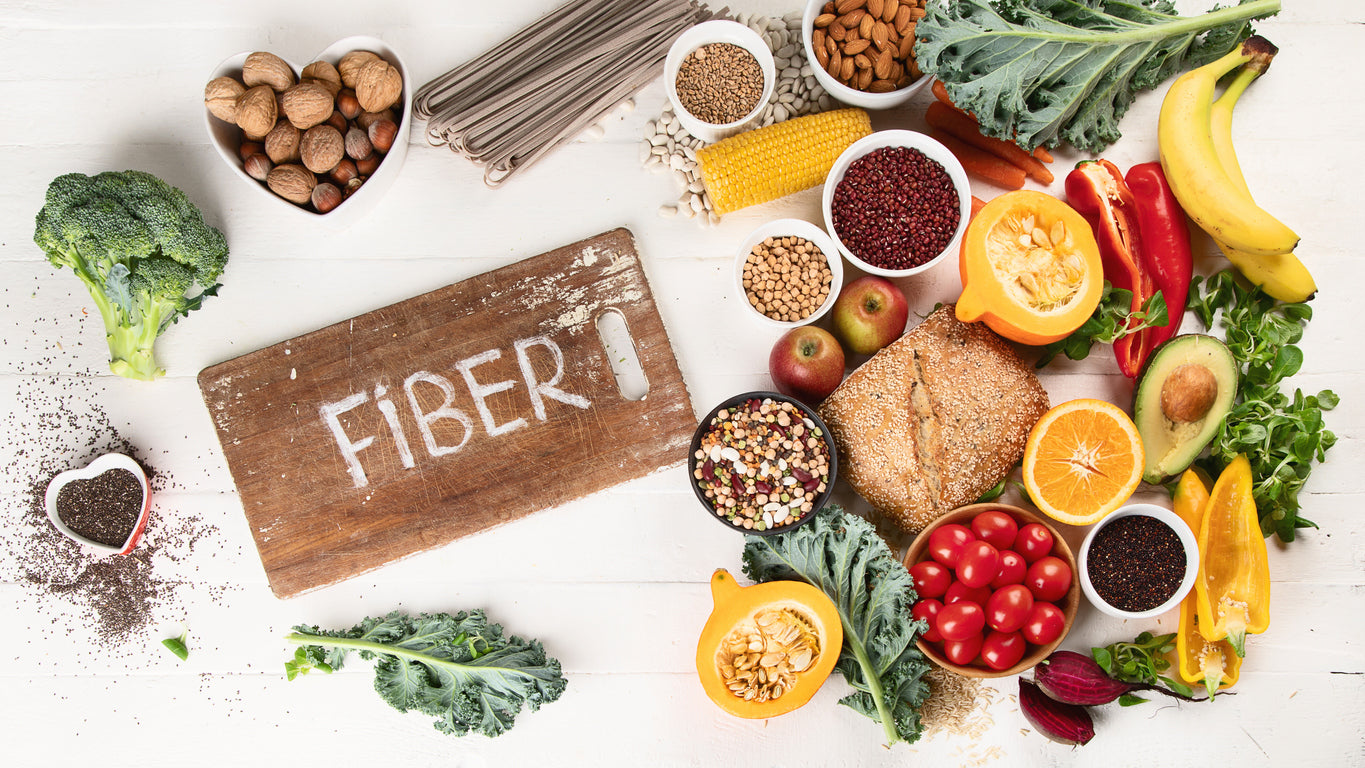
Legumes: Lentils (~16g/cup), black beans (~15g/cup), kidney beans (~13g/cup), chickpeas (~12g/cup)
-
Seeds: Chia seeds (~10g/oz), flaxseeds (~8g/oz)
-
Vegetables: Artichoke (~10g/medium), broccoli (~5g/cup), Brussels sprouts (~4g/cup)
-
Fruits: Raspberries (~8g/cup), pear with skin (~5.5g/medium), apple with skin (~4.4g/medium)
Soluble vs Insoluble Fiber: What You'll Actually Find in Food
In practice, most whole plant foods contain both soluble and insoluble fiber — just in different ratios. Oats, for example, are particularly rich in soluble fiber (specifically beta-glucan), while wheat bran is predominantly insoluble. Legumes are well-balanced between the two.
Here’s a few real-world examples:
-
Apple with skin: soluble fiber in the flesh, insoluble fiber in the skin
-
Flaxseed: about 30% soluble and 70% insoluble
-
Lentils: roughly equal mix of both types
-
Psyllium husk: about 80% soluble, 20% insoluble — one of the most soluble-fiber-dense foods or supplements available
Quick Note: How Food is Classified
We tend to classify foods based on whatever nutrient is most abundant. For example, even though pasta contains some protein, it’s made up of mostly carbohydrates, so we refer to it as a carbohydrate or just a “carb”.
It’s not that pasta is pure carbs, it’s just that it’s mostly carbs so we refer to it as such. This applies to everything, and it can be confusing… Just keep in mind that most foods in nature contain a combination of nutrients, not just one.
In fact, there’s a lot of foods that we call “hybrids” because they contain a high amount of different nutrients. Chia seeds are a good example, they have high amounts of fat, protein, and carbs (mostly fiber).
This also applies to foods we refer to as fiber. For example, psyllium husk is >95% fiber, so we refer to it as fiber, and because that fiber is mostly soluble fiber, we refer to it as soluble fiber, even though it contains some insoluble fiber too.
Supplements
For most people, consistently hitting fiber targets through food alone is a real challenge. The average American gets about 10–15 grams per day — less than half the recommended amount (more on this later). Supplements can help close that gap without overhauling our entire diet.
However, fiber supplements are not all the same. They differ in type, mechanism, and what they're best suited for. Here's how the main categories break down:
Fiber supplements are not all the same. The same classification we used for fiber types — gel-forming soluble, non-gel-forming soluble, and blends — applies directly to supplements. Understanding which category a product falls into tells you a lot about what it will and won't do for you.
Gel-Forming Soluble Fiber: Psyllium Husk
Psyllium husk is the most well-researched fiber supplement available and the gold standard in this category. It's about 80% soluble fiber and forms one of the thickest gels of any fiber — which is why it has such a pronounced effect on blood sugar, LDL cholesterol, and bowel regularity. It has decades of clinical evidence behind it and is the active ingredient in Lusy.
If your goal is to support regularity and metabolic health — stabilizing blood sugar, lowering cholesterol, feeling full for longer — psyllium husk is the absolute best option. It's the most versatile and best-supported fiber supplement available.
Metamucil
The dominant product in this category — and the one most people think of when they hear "psyllium fiber supplement" — is Metamucil. It's been around since 1934 and it's available in virtually every pharmacy and grocery store.
Having said that, Metamucil has a few things we don’t really like:
-
They add maltodextrin to "make it easier to mix", and it’s actually the second most abundant ingredient in their formulas.
-
Most of their products use artificial sweeteners, colors, and flavors.
-
Their flavors are not great, and although they have 2-3, orange is usually the only one in stock.
-
They don’t produce fun and educational content to connect with customers.
This is exactly what motivated us to build Lusy at Transparency Foods. We believe that after 90+ years of success, they have been resting on their laurels, so we decided to shake them up!
Lusy

We created Lusy to solve the issues above:
- Lusy uses premium, organic psyllium husk.
- Because it is so good, there’s no need to add maltodextrin to make it possible to mix.
- Lusy only uses natural ingredients: natural flavors instead of artificial flavors, monk fruit and stevia instead of aspartame, and beet juice powder for color instead of yellow 6.
- We launched with a delicious Strawberry Lemonade flavor instead of the standard orange flavor, and we will be launching more flavors soon.
- We are producing increasingly more fun and educational pieces of content, as the one you’re consuming right now.
I’m also very proud to say that we managed to bring this product to market at a very competitive price. There’s already too many overpriced supplements out there, and this is not one of them. You can get Lusy for anywhere between $0.4 and $0.5 per serving, and we are talking about a clinically-backed serving of 5 grams of psyllium husk, not a random amount.
Lusy has higher quality ingredients, and in our opinion, it also tastes better, which is very important. The better it tastes, the more likely we are to actually use it daily (and getting loved ones to use it too), which is necessary to benefit from psyllium husk.
Non-Gel-Forming Soluble Fiber: Inulin, Wheat Dextrin, and Others
These supplements dissolve in water but don't form a gel. Their primary role is prebiotic — they pass through to the colon and are fermented by gut bacteria, producing the short-chain fatty acids that support gut lining health, immune function, and microbiome diversity.
The main options in this category:
-
Inulin: It’s usually derived from chicory root and it’s one of the most studied prebiotic fibers. Selectively feeds Bifidobacterium and Lactobacillus. Available as a standalone supplement and widely used as an additive in functional foods.
-
Wheat dextrin: This is the active ingredient in Benefiber. Dissolves completely and is tasteless, making it easy to mix into any beverage or food. It’s a mild prebiotic effect with good tolerability.
-
FOS (fructooligosaccharides): This is similar to inulin in function, often derived from chicory or synthesized from sucrose. Frequently combined with inulin in gut-health-focused products.
-
Acacia fiber: This is a gentle, well-tolerated prebiotic that's particularly suitable for people with sensitive digestive systems.
One practical note: Because non-gel-forming fibers are a more powerful prebiotic, they tend to cause significantly more gas and bloating than gel-forming soluble fibers like psyllium, especially when introduced quickly or at high doses.
Blends
Some supplements combine gel-forming and non-gel-forming fibers in a single product, targeting both metabolic health and gut microbiome support at once. A typical blend might pair psyllium husk with inulin or FOS — covering blood sugar, cholesterol, regularity, and prebiotic feeding in one serving.
These are a good option if you want comprehensive fiber coverage without taking multiple separate supplements. However, it’s important to make sure you are actually getting enough of each, which usually entails consuming multiple servings at a time. It’s very common for brands to add less than the scientifically proven amount of a given ingredient to claim its benefits on their marketing.
Benefits
Fiber is one of the most underrated nutrients in nutrition. Most people associate it with digestive regularity and stop there — but the research goes much further. Here's a full breakdown of what fiber actually does for our health.
Regularity and Digestive Health
This is the benefit most people know and for good reason… It's very real. Insoluble fiber adds bulk and speeds up transit time through our colon, and soluble fiber (specially the gel-forming type) keeps stool soft by absorbing water. Together, they make bowel movements easier and more regular.
Chronic constipation affects roughly 16% of adults and up to 33% of adults over 60. In most cases, it's directly tied to low fiber intake. Increasing dietary fiber — especially psyllium husk — is one of the most effective interventions available, with strong clinical backing.
Gut Health
The gut contains trillions of microorganisms, collectively known as the gut microbiome. These microbes interact with processes like immunity, metabolism, and inflammation. Many of them rely on dietary fiber as a key energy source.
Certain fibers (often called prebiotic fibers) are fermented by gut bacteria in the colon. During this process, bacteria produce beneficial short-chain fatty acids (SCFAs) such as butyrate, acetate, and propionate. These compounds play roles in colon health, immune function, and metabolic regulation.
Appetite Control
Consuming fiber helps you feel full for longer. Soluble fiber slows gastric emptying, meaning food stays in our stomach longer, and insoluble fiber adds physical bulk. Both effects signal satiety to our brain, reducing the urge to eat between meals.
Research consistently shows that higher fiber intake is associated with lower overall caloric consumption, lower BMI, and better weight management outcomes without requiring deliberate calorie restriction.
Try it! Next time you are very hungry, eat a bowl of veggies before eating the rest of your meal, or maybe even have a glass of Lusy. You'll feel in less of a rush to finish the rest of your meal and likely will eat less overall.
Blood Sugar Control
When we eat carbohydrates, they break down into sugar and enter our bloodstream. The speed of that process determines how big the blood sugar spike is. We don’t want big sugar spikes… that means that for a period of time we’re overwhelming our body with sugar. Over time, doing this consistently leads to insulin resistance (among many other things like inflammation and oxidative stress), which leads to type 2 diabetes.
Gel-forming soluble fiber significantly slows down the absorption of whatever sugar or starch we eat next. The gel it forms in our digestive tract physically slows the rate at which sugar is absorbed into the bloodstream, leading to smaller, more gradual rises in blood glucose after meals.
This matters for everyone, not just people managing diabetes. Blood sugar spikes followed by crashes cause fatigue, brain fog, mood swings, and cravings. And chronically elevated blood sugar over time is the root driver of insulin resistance and type 2 diabetes.
Lower LDL Cholesterol
Gel-forming soluble fiber like psyllium binds to bile acids in the small intestine and prevents them from being reabsorbed. The liver then has to pull cholesterol from the bloodstream to manufacture new bile acids. The result: lower circulating LDL ("bad") cholesterol.
A meta-analysis published in the American Journal of Clinical Nutrition found that just 5–10 grams of soluble fiber per day reduced LDL cholesterol by 8.28 mg/dL on average. A meaningful reduction considering it comes from food and supplements, not medication.
How Much Fiber Do We Need?
The recommended daily intake, set by the Dietary Guidelines for Americans, is:
Women: 25 grams per day
Men: 38 grams per day
Here's the problem: roughly 95% of Americans don't hit those numbers. The average person gets only 10–15 grams per day — less than half the recommendation. This is so widespread it's been called the "fiber gap," and the downstream effects are real: digestive issues, blood sugar dysregulation, elevated cholesterol, increased inflammation, and a depleted gut microbiome.
The good news: you don't need to close the gap all at once. Adding even 5–10 extra grams per day produces measurable improvements. Small, consistent changes add up.
Start With Food, Then Supplements
The best place to start is food. Focus on adding high-fiber whole foods to your existing meals before reaching for a supplement:
-
Swap refined grains for whole grains (oats, barley, whole wheat bread)
-
Add legumes to salads, soups, or as a side two to three times a week
-
Eat fruit with the skin on when possible
-
Add chia seeds or flaxseeds to smoothies or yogurt
If food alone isn't getting you there — which is the case for most people — a fiber supplement is a smart addition. Psyllium husk, like the one in Lusy, is a great starting point: it's well-tolerated, versatile, and has clinical evidence behind every major benefit fiber is associated with.
One practical note: increase your fiber intake gradually. Jumping from 10 grams to 35 grams overnight can cause bloating and discomfort. Give your digestive system and gut bacteria a few weeks to adjust, and make sure to drink more water as you increase intake.
Summary
Fiber is a type of carbohydrate the body cannot digest, which allows it to pass through our digestive system all the way to the gut and drive key health benefits.
There are two main types, with an important distinction within soluble fiber:
-
Soluble Fiber: Dissolves in water, and it’s divided into two main types
-
Gel-forming soluble fiber: Forms a thick gel. Psyllium Husk is the most popular and researched type of gel-forming soluble fiber. It helps with constipation and bloating, reduces blood sugar spikes, lowers LDL cholesterol, and improves satiety. It also has a mild prebiotic effect. This is where Lusy, the supplement we created, falls in.
-
Non-gel-forming soluble fiber: Does not form a gel. Inulin and wheat dextrin (as in Benefiber) are the most popular types of non-gel-forming soluble fiber. It is fermented by gut bacteria, acting mainly as a prebiotic to support the microbiome.
-
Insoluble Fiber: Does not dissolve in water, and it does not form a gel. It mainly adds bulk to stool, helping with bowel movements.
Most people don’t get enough fiber from food alone. Supplements help fill the gap, but different types serve different purposes. Psyllium (used in Lusy) is best for digestive and metabolic health, while non-gel fibers are better for microbiome support.
Overall, fiber is essential for gut health, blood sugar control, cholesterol reduction, and appetite regulation—and even small increases in intake make a meaningful difference.
Share:
How Lusy Supports Your Gut Microbiome
Psyllium Husk: The Ultimate Guide (2026)