
Table of Contents
What Is Psyllium Husk?
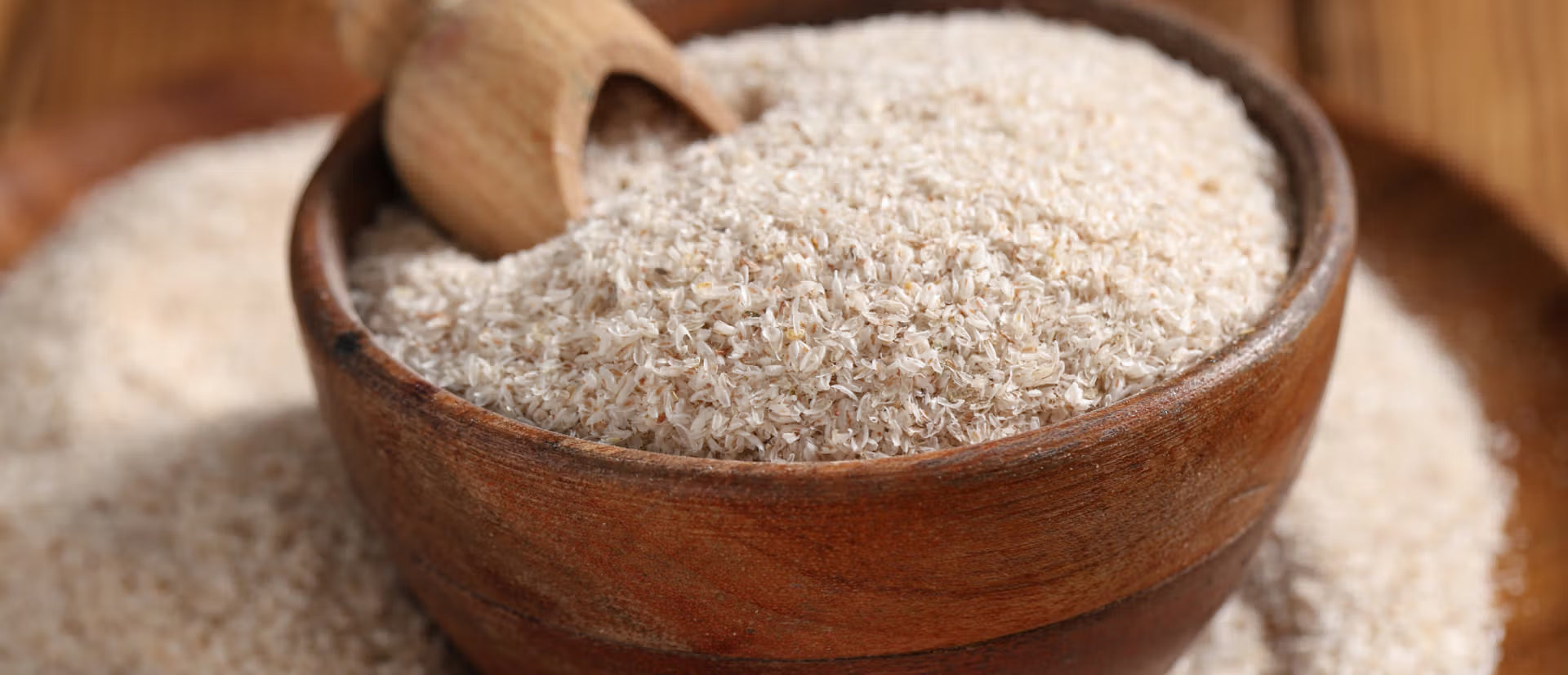
Psyllium husk is the outer seed coat — the husk — of the Plantago ovata plant, a small herb native to South Asia also known as Psyllium.
The psyllium plant produces tiny seeds surrounded by a thin, fibrous shell. That shell is what we call psyllium husk, and it's where virtually all of the fiber and health benefits of the psyllium plant come from.
Parts of the Psyllium Plant: Husk vs. Seed
Let’s dive a bit deeper into the difference between the seed and the husk of the psyllium plant:
-
Psyllium seed: This is the whole seed, including the inner kernel. The seed contains oils and proteins in addition to fiber. Its total fiber content is around 40%.
-
Psyllium husk: This is just the outer coat of the seed. It's almost entirely fiber, roughly 85–90% dietary fiber by weight (much more than the seed), with the soluble fraction making up about 70% of total fiber and the insoluble fraction making up the remaining 30%. Most importantly, as we will learn in a bit, it’s high in a mucilaginous fiber called arabinoxylan.
Something to keep in mind: When you see "Psyllium Husk" on a supplement label, you're getting just the husk, which has the highest amount of fiber. When you see just "Psyllium," it might include the whole seed, resulting in a much lower fiber concentration.
Most clinical research and most quality fiber supplements use psyllium husk, so it’s important that you get psyllium husk if you’re trying to get those benefits (more on these benefits later).
What Makes Psyllium Husk Special
What makes Psyllium Husk special is that it’s mostly made up of mucilaginous fiber called arabinoxylan, a type of fiber that produces mucilage, a thick, gel-like substance, when it contacts water. As we will learn later, this mucilage is the active mechanism behind most of psyllium's health benefits.
Where is Psyllium produced?
India produces approximately 85% of the world's psyllium supply, primarily in the state of Gujarat, where the climate and soil conditions are ideal for cultivation. It’s very common for the production of any given to be concentrated in a small area where conditions are most favorable.
As a quick side note… The same applies to Monk Fruit, where 98% of all the world’s supply comes from a small region in China called Guilin. We sell monk fruit extracts and we have bought well over 10,000 kg of monk fruit extract from multiple suppliers over the years, and it doesn’t make sense to source from anywhere else other than from companies in that region. They have the highest quality products and best infrastructure.
Types of Psyllium Husk
The psyllium husk can be processed in different ways and result in significantly different products. Let’s explore the different types:
Format: Whole Husk vs. Powder
After the Plantago ovata seeds are harvested, they go through a milling process to separate the husk from the inner seed. The husks are then dried and can be sold as-is — whole husk — or further milled into a finer powder. Both forms are functionally similar, but there are practical differences:
-
Whole husk has a coarser, more granular texture. It takes longer to hydrate and form a gel, and it produces a thicker, more textured consistency when mixed with water.
-
Powder is more finely milled, which increases surface area and speeds up hydration. It dissolves more completely and produces a smoother consistency. It's generally easier to mix into beverages or foods.
Psyllium Husk Powder is, by far, more widely used than whole husk.
Purity Level
Psyllium husk is sold at different purity levels — typically ranging from 85% to 99% — and this is one of the most important quality dimensions to understand when evaluating different options.
Purity in this context refers to the percentage of psyllium husk in the raw material. The remaining percentage is made up of naturally occurring impurities from the milling process: seed fragments, fine dust, plant debris, and other non-husk material that wasn't fully separated during processing. Higher purity means a cleaner, more concentrated product with more fiber per gram and less extraneous material.
Here's how the main purity grades compare:
-
85%-90% Purity: This the entry-level commodity grade. It's widely available, the least expensive, and what you'll typically find in bulk agricultural supply chains. At this purity, roughly 15% of the raw material is non-husk content. The fiber yield per gram is lower, and the product may have a slightly off-white or beige color from seed fragment contamination. It’s functional but not refined.
-
95%+ Purity: This is a meaningful step up that starts to matter for products where consistency and clean labeling are priorities. The fiber content per gram is noticeably higher, the color is lighter, and the taste is cleaner. This is the grade where the sensory experience — texture in water, neutral flavor, appearance — clearly differentiate from lower grades.
You might be wondering… “so, which purity should I look for?”. For a daily supplement, especially one meant to be mixed into a beverage, we believe 95% is very much worth the upgrade. The taste, texture, appearance, and nutritional profile are all meaningfully better.
Mesh Size
When psyllium husk is ground into powder, the fineness of the grind is measured by mesh size — a number that refers to how many openings per inch exist in the sieve the powder passes through. A higher mesh number means a finer grind.
-
20-30 Mesh (Coarse): Often used in tablets, capsules, or bulk powders where a coarse texture is acceptable or preferred.
-
40 Mesh (Medium/Coarse): Commonly used in pharmaceutical blends and for products requiring a thicker, more fibrous texture.
-
60-100 Mesh (Fine): Ideal for health drinks where maximum solubility, quick dispersion, and a smooth mouthfeel are needed.
If you've tried psyllium before (especially as a drink mix) and found the texture unpleasant, there's a good chance the product used a coarser grind.
For a daily drink mix supplement, 60 or higher mesh works best. If you are planning on using psyllium husk for baking, you can easily get away with using a lower mesh.
Organic vs Conventional
Both organic and conventional psyllium husk provide the same core benefit: a natural, gel-forming fiber that supports a variety of health benefits.
The reason a lot of people prefer organic is that psyllium husk is the outer layer of the psyllium seed—the part directly exposed to the environment as the plant grows. It can come into contact with soil, water, and agricultural inputs (including pesticides). This makes those exposures more relevant compared to ingredients where the outer layer is removed before consumption.
Organic psyllium is grown under strict standards that limit the use of synthetic pesticides and fertilizers, and this can reduce exposure to certain chemical residues.
We use organic psyllium husk in our product (Lusy), but transparently, what matters most isn’t whether psyllium is organic or conventional—it’s how clean and well-tested the product is. Factors like purity and rigorous testing for contaminants like heavy metals, mycotoxins, pesticides, and microbes play a much bigger role in quality and safety.
For example, a conventional 95% purity psyllium husk product is very likely a far better product relative to an organic 85% purity psyllium husk product. The latter will not only taste and feel worse, but it will probably have higher levels of heavy metals (specially lead) and also higher levels of mycotoxins.
In conclusion, organic just means that it's likely to have less pesticide residues. It ads another layer of safety, but it is not sufficient. The product must also be clean in other ways (heavy metals, mycotoxins, and microbes), and this is accomplished through rigorous testing and quality control processes.
What Psyllium Husk Does in the Body
To understand how psyllium works, it helps to follow it through the digestive tract step by step. This is what happens when we consume psyllium husk:
In the stomach
Within minutes of ingestion, psyllium absorbs water and begins forming a gel. This gel increases the volume and viscosity of stomach contents, which slows gastric emptying — the rate at which food moves from the stomach into the small intestine. This is the first mechanism behind psyllium husk's benefits. It helps us feel fuller for longer, and it slows the absorption of carbohydrates (sugars & starches), leading to lower blood sugar spikes.
In the small intestine
As the gel moves into the small intestine, it coats the intestinal wall and physically slows the absorption of nutrients, most importantly glucose. This leads to lower blood sugar levels.
Also, bile acids (which our liver uses to digest fat and which contain cholesterol) bind to the psyllium husk gel and get carried along rather than being reabsorbed. As a result, the liver then has to draw cholesterol from the bloodstream to make new bile acids — lowering circulating LDL.
In the colon
The gel arrives with significant water content, softening stool and adding bulk. This makes passage easier and more regular. The insoluble fraction of psyllium adds additional bulk and helps speed transit time.
A portion of the soluble fraction is fermented by gut bacteria, producing short-chain fatty acids that benefit overall gut health — though this effect is more limited in psyllium than in fully prebiotic fibers, more on this later.
In elimination
Only a small fraction of Psyllium Husk is fermented in the body, so most simply passes throughout our digestive system unchanged and it’s excreted along with bound waste.
One of the things that makes psyllium special when it comes to regularity and overall digestive health, is that because psyllium normalizes both stool consistency and transit time — softening hard stool and firming loose stool — it's effective for both mild constipation and diarrhea.
Benefits of Psyllium Husk
Psyllium has one of the broadest and most thoroughly documented evidence bases of any dietary supplement. Here's what the research shows:
Digestive Regularity and Constipation Relief
This is where psyllium's reputation was built — and for good reason. The combination of soluble gel (which softens stool) and insoluble bulk (which speeds transit) makes it one of the most effective interventions for chronic constipation available without a prescription. Clinical guidelines consistently list psyllium as a first-line recommendation for constipation.
As you probably know, this is the active ingredient in Metamucil and has been recommended by physicians for this purpose since the 1930s. By the way… we believe that Metamucil is due for some healthy competition, so we created what we believe is a much better product. It’s called Lusy and you can find it here. Most people notice a meaningful improvement in regularity within 1–3 days of consistent use.
Note: please make sure to read the side effects and precautions section of this article before taking any psyllium husk supplement.
Blood Sugar Control
Psyllium's gel slows the rate at which glucose from a meal enters the bloodstream. This reduces the height of the post-meal blood sugar spike — which matters both for immediate wellbeing (energy, focus, mood) and long-term metabolic health (insulin sensitivity, diabetes risk).
A meta-analysis of 35 randomized controlled trials found that psyllium supplementation significantly reduced both fasting blood glucose and HbA1c (a measure of long-term blood sugar control) in people with type 2 diabetes.
For people without diabetes, the effect on post-meal glucose spikes is still meaningful. Timing matters here: psyllium is most effective for blood sugar when taken with or just before a carb-heavy meal, so the gel is in place to slow absorption as food is digested.
LDL Cholesterol Reduction
This benefit has arguably the strongest and most consistent evidence behind it — strong enough to earn psyllium an FDA-authorized health claim, which you can find in Lusy’s packaging.
Here’s how it works: as psyllium gel moves through the small intestine, it binds to bile acids and prevents them from being reabsorbed into the body. The liver must then synthesize new bile acids to replace them, which requires pulling LDL cholesterol from the bloodstream. The result is a measurable, dose-dependent reduction in circulating LDL.
A 2018 meta-analysis of 21 randomized controlled trials found that psyllium supplementation reduced LDL cholesterol by an average of 12.6 mg/dL — a clinically meaningful reduction that's comparable to what some mild cholesterol-lowering medications achieve. The effect is more pronounced in people with elevated baseline LDL and when combined with a low-saturated-fat diet.
The FDA health claim: In 1998, the FDA authorized a health claim for psyllium husk and cardiovascular disease — one of only a handful of ingredients to ever receive this designation. The claim states that diets low in saturated fat and cholesterol that include 7 grams of soluble fiber per day from psyllium seed husk may reduce the risk of heart disease. To make this claim, a product must contain at least 1.78 grams of soluble fiber from psyllium per serving.
Satiety and Weight Management
Psyllium's gel slows gastric emptying. This means that food stays in our stomach longer, which sends stronger satiety signals to the brain. This translates into reduced hunger between meals and, over time, lower overall caloric intake.
A meta-analysis of 22 trials found that psyllium supplementation significantly reduced appetite scores and food intake compared to control groups. The effect was most pronounced when psyllium was taken 30–60 minutes before a meal, giving the gel time to form before eating begins.
Unlike appetite suppressants or stimulant-based weight loss products, psyllium's satiety effect is purely mechanical — no stimulants, no hormonal manipulation, just the physical effect of a gel in our digestive tract.
Diarrhea and IBS Management
Psyllium's gel-forming property works in both directions. In cases of loose or watery stool, the gel absorbs excess water and firms stool consistency. This makes psyllium effective for diarrhea — including traveler's diarrhea and diarrhea associated with irritable bowel syndrome (IBS-D).
For IBS specifically, psyllium holds a unique position: it's one of the few fiber supplements recommended across both major subtypes — IBS-C (constipation-predominant) and IBS-D (diarrhea-predominant). A 2009 randomized trial published in the British Medical Journal found that 10g/day of psyllium significantly reduced IBS symptom severity compared to placebo and wheat bran. The improvement was most pronounced in IBS-C, but IBS-D patients also showed benefit.
Psyllium husk is generally better tolerated than high-fermentability fibers (like inulin or FOS) in IBS patients, because less fermentation means less gas and bloating. We’ll learn more about this in the “Psyllium Husk vs Other Fibers” section later in this article.
Gut Microbiome Support
Studies have found modest increases in beneficial bacterial populations (particularly Bifidobacterium and Lactobacillus) with consistent psyllium husk use, along with some production of short-chain fatty acids.
Psyllium husk is only partially fermented in the colon — less so than fully prebiotic fibers like inulin, so this is a real but secondary benefit. If gut microbiome support is a primary goal, I would consider pairing psyllium with a prebiotic fiber supplement (like inulin or wheat dextrin) to cover both bases. Remember, psyllium husk has multiple unique benefits that these prebiotic fibers don’t (more on this in the “Psyllium Husk vs Other Fibers” section).
The good news is that psyllium's partial fermentability is actually an advantage for tolerability. Fibers that ferment rapidly and completely (like inulin and FOS) tend to cause significant gas and bloating — especially when first introduced. Psyllium's slower, more limited fermentation means far less digestive discomfort, which is one reason it's better tolerated by most people, including those with sensitive GI tracts.
Psyllium Husk vs Other Fiber Supplements
For most people, consistently hitting fiber targets through food alone is a real challenge. In fact, it’s estimated that 9 out of 10 Americans don’t meet their daily fiber intake. This is referred to as the great “fiber gap”.
So, all additional fiber is highly encouraged! As it’s almost certainly going to be net positive for our overall health. However, it’s also important to understand that not all fiber is the same, and which fiber is best for you will be based on what you are trying to get out of it.
Let’s compare psyllium husk to some of the other most popular types of fiber:
|
Fiber |
Type of Fiber |
Gel-forming |
Prebiotic |
Best for |
|
Psyllium husk (Lusy & Metamucil) |
~70% soluble ~30% insoluble |
Yes! |
Mild |
Regularity, Satiety, Blood Sugar Control, Lower LDL cholesterol, and IBS. Mild gut microbiome support. |
|
Wheat dextrin (Benefiber) |
Soluble |
No |
Medium |
Smooth gut microbiome support. Easy to drink and stick to (less gas). |
|
Inulin |
Soluble |
No |
Strong |
Strong gut microbiome support. More effective but also more gas. |
|
FOS (fructooligosaccharides) |
Soluble |
No |
Strong |
Strong gut microbiome support. More effective but also more gas, even more than inulin.. |
If gut microbiome support is your main objective, then psyllium husk might not be the best option. I would choose between wheat dextrin, inulin, or FOS depending on what works best for you; there’s a few other fibers that work well for this purpose (like Acacia Fiber) but these three are the most common.
However, if regularity (reduced constipation and bloating) and metabolic health (satiety, blood sugar control, Lower LDL cholesterol) are your main objectives, then psyllium husk is the absolute best option. There’s really no close second, especially considering it has the broadest evidence base and the most clinical applications of any fiber supplement.
Types of Psyllium Husk Supplements
If you decide to try psyllium husk, you’ll probably want to know what supplement is best for you and why. This is very important. As you will see, some formats like pills make it unrealistic for you to consistently take the right daily dose, while others, like gummies, don’t really have psyllium husk and the ones that do contain very little. And of course, you’ll also learn that some drink mixes might be better than others ;).
Drink Mixes
Drink mixes are the most popular and clinically well-established format for psyllium supplementation. They are made up of psyllium husk powder, along with flavors, sweeteners, and colors to make it taste and look good.
You mix a scoop or measured serving of psyllium powder into a glass of water, stir, and drink. The format works well because it delivers psyllium in the hydrated state it needs to be in to form a gel — there's no capsule to dissolve, no delay before the fiber starts working. You're also in full control of the dose, and it's very easy to take the right amount.
Metamucil
The dominant product in this category — and the one most people think of when they hear "psyllium fiber supplement" — is Metamucil. It's been around since 1934 and it's available in virtually every pharmacy and grocery store.
Having said that, Metamucil has a few things we didn’t really like:
-
They add maltodextrin to "make it easier to mix", and it’s actually the second most abundant ingredient in their formulas.
-
Most of their products use artificial sweeteners, colors, and flavors.
-
Their flavors are not great, and although they have 2-3, orange is usually the only one in stock.
-
They don’t produce fun and educational content to connect with customers.
This is exactly what motivated us to build Lusy at Transparency Foods. We believe that after 90+ years of success, they have been resting on their laurels, so we decided to shake them up!
Lusy
We created Lusy to solve the issues above:
- Lusy uses premium, organic psyllium husk.
- Because it is so good, there’s no need to add maltodextrin to make it possible to mix.
- Lusy only uses natural ingredients: natural flavors instead of artificial flavors, monk fruit and stevia instead of aspartame, and beet juice powder for color instead of yellow 6.
- We launched with a delicious Strawberry Lemonade flavor instead of the standard orange flavor, and we will be launching more flavors soon.
- We are producing increasingly more fun and educational pieces of content, as the one you’re consuming right now.
I’m also very proud to say that we managed to bring this product to market at a very competitive price. There’s already too many overpriced supplements out there, and this is not one of them. You can get Lusy for anywhere between $0.4 and $0.5 per serving, and we are talking about a clinically-backed serving of 5 grams of psyllium husk, not a random amount.
Lusy has higher quality ingredients, and in our opinion, it also tastes better, which is very important. The better it tastes, the more likely we are to actually use it daily (and getting loved ones to use it too), which is necessary to benefit from psyllium husk.
Capsules and Pills
Psyllium pills and capsules are very convenient, but there’s a big limitation: it’s very hard to get the right dose.
Each capsule typically contains 500–700mg of psyllium husk, which means you need 8–12 capsules to reach a single therapeutic serving of 5–7 grams. Nobody takes that many capsules to meet their fiber goals.
I personally have friends who bought psyllium husk capsules online, took 1-2 every day, and when they realized it didn’t really do anything, they gave up on psyllium husk altogether. That’s a problem.
Also, capsules also have a slight delay compared to drink mixes: the capsule shell needs to dissolve before the psyllium can begin hydrating and forming a gel. For acute digestive purposes this is a minor issue, but for blood sugar management — where timing relative to meals matters — the delay is worth considering.
In conclusion, capsules are best suited for people who only need a very low dose and want maximum convenience.
Gummies
There’s not really a big psyllium husk gummy market. It’s hard to make gummies with a high concentration of psyllium husk (it gels fast), so the few companies selling it include very little psyllium. They are made up of mostly sugar alcohols and other ingredients.
I still wanted to include this section because Metamucil sells Fiber Gummies (very popular), and a lot of people assume that they contain psyllium husk. They don’t contain psyllium husk; they contain Inulin, which we now know has a very different set of benefits than psyllium (refer to the “Psyllium Husk vs Other Fiber Supplements” section for more on this).
Pure Psyllium Husk Powder
Pure psyllium husk powder is exactly what it sounds like — just the husk, with nothing added. No flavors, no sweeteners, no functional additives. It's the most economical format on a per-gram-of-fiber basis and the most versatile: you can stir it into water, blend it into a smoothie, mix it into yogurt, or incorporate it into baking.
The trade-off is that plain psyllium in water has a neutral-to-earthy flavor and a mucilaginous texture that some people find unpleasant, particularly at higher doses. For people who are comfortable with that texture — or who are mixing it into something flavorful enough to mask it — pure powder is a great option. It's also the best choice if you want complete control over what you're consuming, with no additives to account for.
If you're buying pure powder specifically for daily supplementation, it's worth seeking out a 95%+ purity product for better fiber yield and a cleaner taste.
Side Effects and Precautions
There’s a few things to keep in mind before starting to use psyllium husk.
May Initially Cause Bloating and Gas
The most commonly reported side effect, particularly when starting psyllium or increasing the dose quickly. Because psyllium is partially fermented in the colon, gut bacteria produce some gas as a byproduct. This typically subsides within 1–2 weeks as your gut microbiome adjusts. Starting at a lower dose and increasing gradually minimizes this.
Please note psyllium causes significantly less gas than fully fermentable prebiotic fibers (like inulin or FOS) because a much smaller proportion of it actually ferments. People who've had bad experiences with other fiber supplements often find psyllium much more tolerable.
Choking Risk: Always Mix With Plenty of Water
Psyllium must be mixed with sufficient water and consumed before it fully gels. Dry psyllium powder should never be swallowed directly — it can expand in the throat and cause choking. This is particularly relevant for older adults or anyone with difficulty swallowing. Always mix with enough water and drink immediately.
Drug Interactions: Take Psyllium Husk 1–2 hours before/after any prescription medication
Because psyllium slows absorption of nutrients in the small intestine, it can also slow the absorption of certain medications. Take psyllium at least 1–2 hours before or after any prescription medication just to be safe.
Allergies
Psyllium allergy is rare but documented, particularly among healthcare workers who have been occupationally exposed to psyllium dust over long periods. Symptoms can range from mild (sneezing, runny nose) to severe (anaphylaxis in rare cases). If you have a known allergy to psyllium or to other members of the Plantago family, avoid it.
Contraindications: When Contact Your Doctor
If you have Crohn's disease, ulcerative colitis, or any other chronic GI condition, consult your physician before starting psyllium supplementation.
Psyllium Husk is effective at helping with constipation and bloating, but contact a doctor before using if you (1) have recently experienced a sudden change in bowel habits persisting for 2 weeks, abdominal pain, nausea, or vomiting or (2) are pregnant, lactating, have a medical condition, or are taking any medication (see section above on drug interactions).
If constipation lasts more than 7 days or rectal bleeding occurs, stop using and contact a doctor. These may be signs of a serious condition.
Summary
Psyllium husk is a high-fiber ingredient that forms a gel when mixed with water, and this drives its effects in the body:
-
Improves digestion by normalizing stool (helping both constipation and diarrhea)
-
Lowers LDL cholesterol by binding bile acids
-
Reduces blood sugar spikes by slowing absorption
-
It helps us feel full for longer, supporting appetite control
-
It’s also a mild prebiotic, helping support a healthy gut microbiome.
It stands out from other fibers because it has strong evidence for digestive and metabolic health, while being better tolerated than highly fermentable fibers like inulin and FOS.
Effectiveness depends on quality and format. High-purity, fine-mesh psyllium works best, and drink mixes are the most effective way to take it (as opposed to capsules, pills, or gummies).
Metamucil, owned by Proctore and Gamble, is the most popular psyllium husk supplement, but it is made for mass consumption and not the best quality in our opinion (see the Metamucil section for full details on why).
We created Lusy to solve these problems, and we believe that it’s the absolute best psyllium husk supplement in the market. We wanted to make sure it was accessible, so we are very proud of being able to offer it at the very competitive price of $0.47-$0.57 per serving depending on how many bags you get and whether you subscribe or not.
Of course you can also use 100% psyllium husk in your recipes, but we would strongly recommend that you look for a 95%+ purity product for better fiber yield and a cleaner taste.
Overall, psyllium is one of the most proven and practical fiber supplements, if used at the right dose and in the right form.
Share:
How Lusy Supports Your Gut Microbiome
Fiber: The Ultimate Guide (2026)