
About the Author
Hi! I'm Stefano, founder of Transparency Foods — and IBS management is a benefit of psyllium husk I think doesn't get enough attention, mostly because IBS itself is confusing and inconsistent for a lot of people. As you will see shortly, psyllium husk is one of the only fiber supplements that helps regardless of which direction your IBS tends to go (constipation or diarrhea). In this article, we'll explore:
- Why IBS is hard to manage with most fiber supplements
- How psyllium husk — the active ingredient in Lusy — works in both directions
- What the clinical research and guidelines say
- How to use Lusy if you have IBS
- What kind of results to expect
Why IBS Is Hard to Manage
Irritable bowel syndrome doesn't behave consistently. Many people with IBS alternate between constipation (IBS-C) and diarrhea (IBS-D), sometimes within the same week. That makes it genuinely difficult to pick a single intervention — a laxative that helps on a constipated day can make a diarrhea day worse, and vice versa. Most fiber supplements are built with one direction in mind, which is part of why so many people with IBS give up on fiber altogether after a bad experience.
How Psyllium Husk Works in Both Directions
Psyllium husk's gel-forming property is unusual in that it's genuinely bidirectional. The same mucilaginous gel that forms when psyllium contacts water responds differently depending on what it encounters:
- When stool is too hard, the gel draws in water and softens it, relieving constipation.
- When stool is too loose, the same gel absorbs excess water and firms things up, addressing diarrhea.
This dual action is what makes psyllium particularly useful for IBS, where alternating constipation and diarrhea is common. It's not a stimulant laxative and it's not an anti-diarrheal drug — it's a mechanical regulator that normalizes stool consistency regardless of which direction things are off on a given day.
What the Research and Guidelines Say
A 2009 randomized trial published in the British Medical Journal found that 10g/day of psyllium significantly reduced IBS symptom severity compared to both placebo and wheat bran — notably outperforming a different fiber source, which underscores that not all fiber behaves the same way for IBS specifically. Several clinical guidelines for IBS management list psyllium as a first-line intervention, ahead of many other dietary approaches.
Psyllium is also generally better tolerated than high-fermentability fibers like inulin or FOS in people with IBS, because it ferments much less in the colon. Less fermentation means less gas production — which matters a lot for a population that's often already sensitive to bloating and gas.
How to Use Lusy If You Have IBS
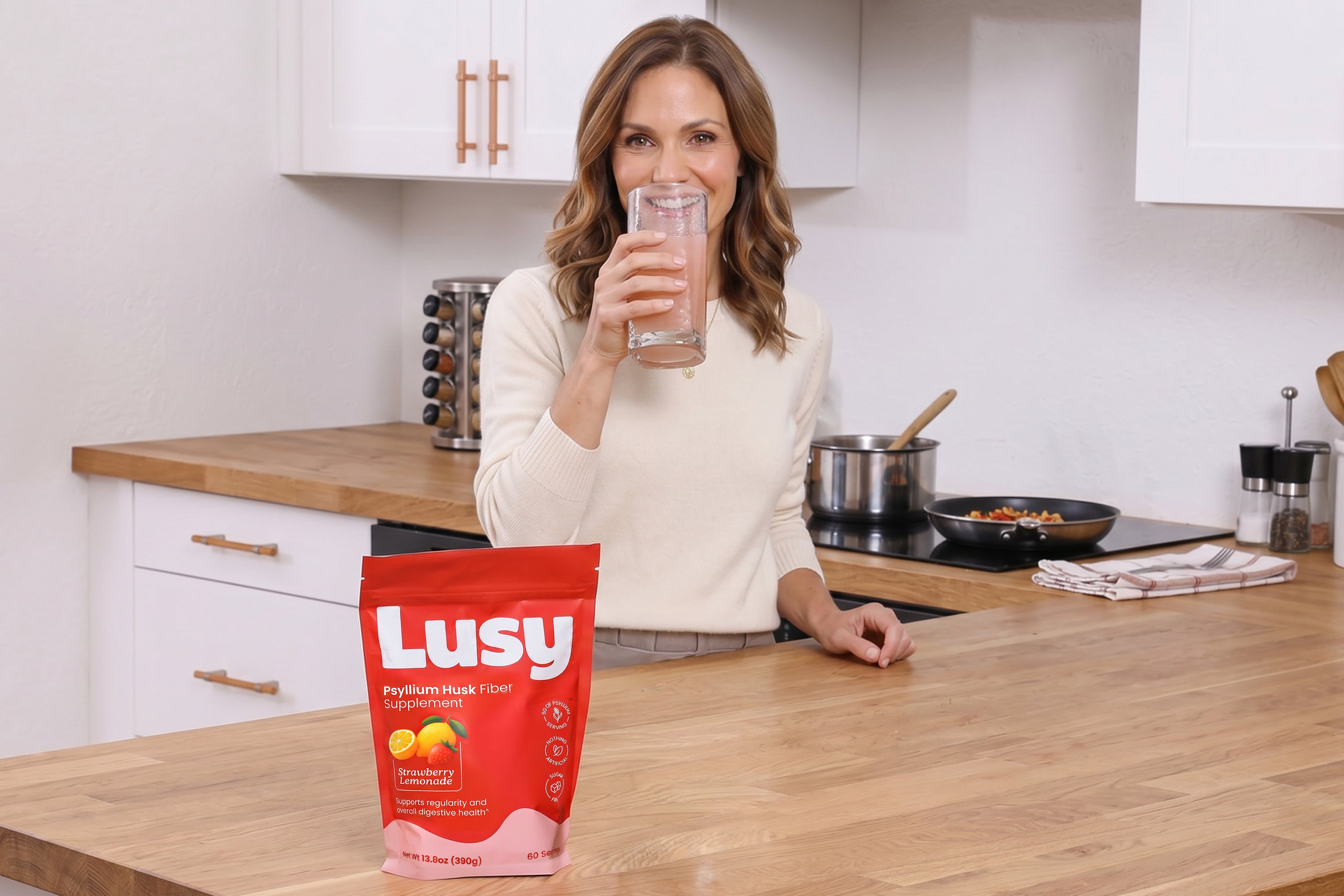
The doses used in IBS trials tend to run higher than for general regularity — around 10–15 grams per day. Each scoop of Lusy delivers 5 grams, so two servings a day gets you into that range.
- Start low and increase slowly. This matters more for IBS than almost any other use case — a sensitive gut can react to a sudden jump in fiber with more bloating than it's worth. Start with half a serving for the first couple of weeks.
- Always mix with a full glass of water (at least 8 oz / 240ml), since the gel needs adequate fluid to do its job properly in either direction.
- Be consistent rather than reactive. Psyllium works best as a daily habit that keeps things regulated, rather than something you reach for only on a bad day.
Finally, please keep in mind this is general advise. Always talk to your doctor before making any big changes.
Why Lusy Specifically
Because IBS guts tend to be more sensitive, the quality of the psyllium matters even more here. We use organic, high-purity and high mesh psyllium husk, which hydrates fully and mixes cleanly — a coarser, lower-grade psyllium can leave gritty, undissolved particles that are more likely to irritate a sensitive digestive system. We also avoid the artificial sweeteners some competing products use, which have been associated with digestive discomfort in some people with sensitive guts. You can find Lusy here.

What to Expect
Because IBS symptoms fluctuate on their own, it can take a few weeks of consistent use to tell whether psyllium is genuinely helping versus a naturally good stretch. Give it at least 3–4 weeks of daily, consistent use before judging the effect. If you notice increased bloating in the first week or two, that's typically temporary — slowing your dose increase usually resolves it.
If you have Crohn's disease, ulcerative colitis, or any other chronic GI condition beyond IBS, talk to your doctor before starting — psyllium's mechanism is generally beneficial for IBS specifically, but other GI conditions can respond differently.
Closing Thoughts
IBS is frustrating precisely because it doesn't behave consistently, and most interventions only address one half of the problem. Psyllium husk's bidirectional gel is one of the few tools that works regardless of which way your symptoms are trending on a given day. Start slow, stay consistent, and give it a few weeks to show its full effect.
Share:
How Lusy Supports Your Gut Microbiome
Fiber: The Ultimate Guide (2026)